
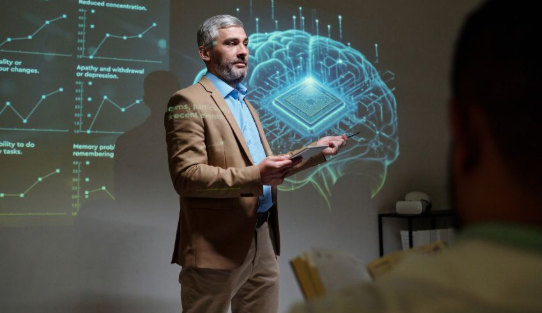
In the market, the usage of artificial intelligence (AI) is transforming business, data, and staff. AI for IT not only automates basic tasks but also optimizes the flow of data, automatically correlates information, and enables proactive data management. The use of artificial intelligence for IT has opened a new dimension of IT training for organisations.
Traditional IT training classes and programmes are often structured around set courses and certifications and classroom based learning. While this type of program still has its role, it may not be flexible enough to deal with the fast-moving change that is happening in technology. AI-based teaching tools, customised training packages and virtual labs are enabling people to learn more effectively.
The work of IT trainers and training providers will always need to be at the right mix of educating and providing practical experience to IT learners. As AI grows in the technology world, they will need to keep learning to adapt their skills to new jobs and market needs.
Global IT Training Market Growth and the Influence of AI
The worldwide IT Training market size was estimated at USD 91.85 billion every 2025. The industry is projected to develop at a CAGR of 6.20% during the period 2026-2035, to reach USD 167.62 billion by 2035 as organizations make new ventures and benefit for thought processes and acquire new abilities to set out to stay aware of the occasions.
The increasing adoption of artificial intelligence is also increasing the demand for specialised training around machine learning, generative AI, cloud computing, cybersecurity and data analytics. Organisations are looking for a workforce that will be able to use AI-powered applications, assess the output of these tools and implement them as part of their daily work. IT training is increasing alongside new areas of focus around technology skills.
A further driver for market expansion is the rising adoption of reskilling and upskilling. Workers in all departments are likely to need to know how AI tools impact their work, even if they don’t work in tech. In addition to this, training providers have been introducing new courses and industry-centric training initiatives that include flexible training options, project-based learning models and training programs, which are expected to shape the path organisations take in choosing suitable training providers and preparing employees for future requirements.
How Artificial Intelligence Is Transforming IT Training
Personalisation By harnessing the potential of artificial intelligence, we can make the whole learning journey more personalised, engaging and adaptable to your employees. Employees will no longer follow a one size fits all approach, instead, they will be able to have more and more access to the content they need.
These systems can detect a learner’s understanding of concepts, lack of understanding in certain areas and suggest the user adapt the lessons. For example, a software developer who is learning about machine learning can be advised to do an extra set of exercises on data preparation where they have a weaker foundation. A cyber security specialist could get lessons on advanced threat detection or security automation.
AI enhances the practice of technical skills in other ways. Intelligent coding assistants can clarify programming mistakes, offer guidance and provide explanations for new concepts. Virtual environments can simulate IT infrastructure for employees to learn troubleshooting and security incident response procedures, or for training to take place without risking real business systems.
Such functions could help make training more feasible and effective. Nevertheless, AI generated solutions and guidance still need to be supervised properly. Learners need to check if the information is correct, learn to understand the rationale of the suggested solutions, and learn to solve problems on their own.
Personalised Learning and Adaptive Training Programmes
This is one of the most significant changes in IT education over the past few years. Conventional courses are taught in the same way to everyone from the same starting point, even if students have already mastered that material, or require further assistance.
Personalised training supports organisations in aligning what they train with employees’ job roles. A cloud engineer could undertake a learning journey covering cloud architecture, automating infrastructure and managing AI workloads. An IT support technician could undertake a learning journey covering automated troubleshooting, managing a service and empowering the use of AI assistants.
Adaptable learning, in particular, has the added benefit of making employees feel more in charge of their own careers. Small chunks of learning, such as quizzes and exercises, combined with regular work, enables them to develop expertise at a pace that suits them. This works well for companies with sizable staff populations.
However, personalisation shouldn’t be at the cost of static learning. The training deliverers need to get a good grasp of the basics before moving on to the more advanced work. If a course is structured so that there is a mix of self-study, instructor input and evaluation then the result is more predictable.
The Growing Importance of AI and Data Science Skills
As companies adopt artificial intelligence, professionals will require skills far more advanced than traditional IT expertise. Machine learning, data engineering, natural language processing and generative AI are beginning to become must-have job skills.
There will be increased focus on helping workers to understand AI. IT training courses will need to teach employees how AI systems are built, implemented, checked and maintained. This could include cleaning and preparing data, testing the output of the model, and eliminating bias. Understanding cloud-based infrastructure and application programming interfaces will also be useful as many AI systems will rely on connected software and scalable computing resources.
Not every employee has to become an AI engineer in the meantime. Several professional groups can enhance their productivity by acquiring the skills of working with AI tools in their everyday tasks. Project managers, business analysts, software testers, technical support teams, and others can apply AI to their jobs efficiently.
This has led to a whole range of training providers developing programmes that span from introductory AI fundamentals to more advanced technical courses. These programmes can support organisations in developing a workforce that can adapt new technologies responsibly, by ensuring their curriculum maps to the demands of the job.
Automation, Practical Labs, and Hands-On Learning
Learning from AI will never fully replace hands-on training in IT skills although AI training software will become increasingly sophisticated. Because it’s one thing to grasp an idea by reading or watching a video, quite another to put that idea into practice by solving a technical challenge.
Cloud laboratories enable learners to work in simulated servers, databases, software environments and configurations of security. AI-enabled simulations can create real-world challenges, give instant feedback and highlight the impact of participants’ actions. They can be particularly effective for solving real-world challenges with incident management, debugging of software and monitoring of infrastructure.
Automating these steps means they become the responsibility of automated systems. Automated testing and simple diagnostics – for example, checking basic system specifications or tests which are conducted frequently – can be handled by automation tools. So training courses need to prepare employees to set up these systems, read their results and solve complex problems.
In this scenario, an employee learning about cybersecurity could explore a fake network to look into an unusual pattern of network activity, examine automated alerts, and determine what response to take if there really is a cyber attack. These exercises foster critical thinking and train your team for circumstances that can’t be covered by instructions.
The Role of Human Instructors in AI-Driven Education
While AI can enhance information access and take over some aspects of instruction, IT training trainers will remain needed. Experienced IT instructors are able to elaborate on difficult subjects, offer professional advice and link technological information to business-related issues.
There are additional skills that can be assessed by teachers but may be difficult for automated systems to accurately measure including teamwork, communication, ethical decision making and decision making in uncertain circumstances. These skills are relevant in IT as the worker needs to interact with teams or the general public, and be faced with business decisions.
Trainers will probably be more in the role of mentors, curriculum developers, givers of practical lessons, and assessors of AI-assisted work. We will see human trainers and learning support as a complement to AI-supported learning, not a replacement.
Training providers should also develop transparent policies on the use of AI in assignments and assessments. The directives should include when it is suitable for learners to use AI, how to substantiate AI-generated information, and why it matters to prove competence manually in future professional certification.
Challenges Facing the Future of IT Training
AI training is a promising new service, it raises problems that need careful thinking. Foremost among these problems is the fast pace of technology. Course content may become irrelevant in just a few months, as software platforms, programming languages, and AI solutions are constantly being updated by their respective vendors.
Security and privacy issues. AI systems could collect data about an individual’s assessment results, behaviours and other personal data. Providers of AI-enabled learning platforms will require systems that are safe and secure, transparent practices and robust data protection policies to protect individuals’ information from unlawful use.
A lack of access to technology or services can also make it more difficult to bring about change. Smaller organisations and individuals may not have access to training platforms, cloud laboratories, or specialised certifications that bigger organisations have. Ways to overcome these barriers are through low-cost courses, open educational resources, and hybrid delivery.
Over-reliance on AI tools may also contribute to erosion of core technical skills. Staff and users who only operate solutions and don’t focus on the basic principles may be at a loss if the automation doesn’t work as expected. This means IT training needs to include critical thinking, independent problem solving, and application testing.
Future Opportunities for IT Training Providers and Businesses
Employers and training providers can capitalise on the evolving tech environment. Education providers could build tailored courses on generative AI, cloud security, machine learning operations, data management and AI tools for software development. Courses that teach technical skills alongside sector-based examples may be valuable for organisations using AI across many areas.
Businesses can use their training programmes in a way that prevents skills gaps from developing. Through continual skill assessments, internal learning programmes, mentoring and certification schemes, employees will be supported through their evolving roles and organisations will be able to spot the most rapidly developing skills gaps.
They can also be enhanced through better collaboration between educational institutions and the private sector and technology providers. This would help to adapt course content to workplace realities and make available to learners the latest technologies and real-life projects.
It will also be important to measure the impact of training. Simply looking at who finished the course won’t reveal whether you’ve taken on a smarter, more capable workforce. But businesses can look at the outcomes of practical tests, task performance and debugging time, and whether teams are able to work more intelligently with AI.
Conclusion
The Evolution of Information Technology Training As AI continues to expand and specialised technical skills are in higher demand, the market for IT training will evolve. Innovative learning methods such as AI-enhanced learning and virtual laboratories, along with core knowledge and skills from experienced teachers, will continue to be vital to effective learning.
And as the use of new technologies becomes the norm among enterprises, training programmes will have to shift to cover practical as well as technical needs. Practitioners will have to learn to assess the results generated by artificial intelligence and apply it to a business problem.
Workforces that receive targeted, accessible and on-going IT training will be better prepared for future changes to the way they work. What the most successful future workforce will need to do is combine artificial intelligence with human judgement, real-world learning and ongoing up-skilling.
Author Bio –
Satiyam Kumar is a business and market research content writer at Expert Market Research, specializing in emerging technologies, digital transformation, and global industry trends. He creates informative and research-focused content related to artificial intelligence, technology markets, and business innovation.


