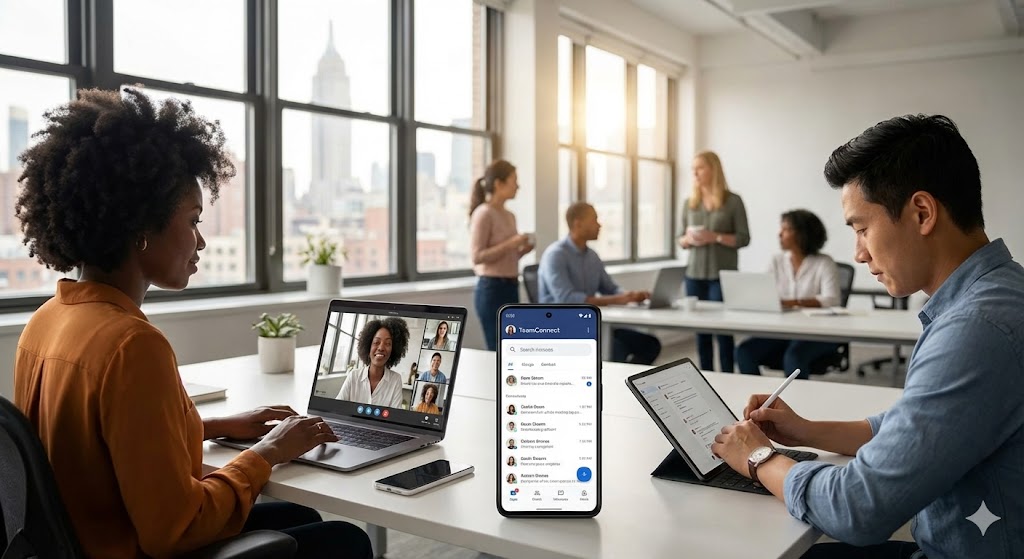
You’ve felt it. That fragmented, “where-did-I-send-that” feeling.
One teammate is Slacking you. Another is ringing your desk phone (which you haven’t touched in three days). A third is sending a calendar invite for a Zoom meeting, but the link is broken. Your communication isn’t just “busy”—it’s broken.
In the fast-paced US market, speed is the only currency that matters. If your team is wasting twenty minutes a day just trying to figure out how to talk to each other, you’re losing money.
Enter UCaaS. It stands for Unified Communications as a Service, but you can just think of it as the end of your digital headaches.
Quick Takeaways: Why UCaaS Matters Right Now
- One Platform to Rule Them All: Phone, video, chat, and SMS in a single app.
- Scalability: Add ten users or ten thousand with a few clicks.
- Cost Efficiency: Ditch the expensive on-site hardware and maintenance.
- Remote Ready: Your office is wherever your laptop is.
What Exactly is UCaaS, Anyway?
Let’s strip away the jargon. UCaaS is a cloud-delivered model that bundles all your communication tools into one neat package.
Back in the day, if you wanted an office phone system, you had to buy a literal “closet of wires” (a PBX system). It was expensive, it broke constantly, and it only worked if you were sitting at your desk.
UCaaS moves that closet into the cloud. Now, your business phone number rings on your smartphone while you’re at a coffee shop in Austin, your laptop while you’re at a conference in Vegas, and your tablet while you’re on the couch.
It’s not just a phone system; it’s a productivity ecosystem.
The Pillars of a Unified System
Most people think UCaaS is just “VoIP on steroids.” It’s much more. To be truly “unified,” a platform usually covers four main bases:
- Voice (Telephony): Traditional call features like call forwarding and voicemail-to-email, but via the internet.
- Video Conferencing: High-definition meetings without the “can you hear me now?” lag.
- Messaging: Real-time team chat and SMS for quick check-ins.
- Collaboration Tools: Screen sharing, file transfers, and integrated task management.
Why Your IT Budget Will Thank You
Let’s talk turkey. In a world of rising overhead, UCaaS is one of the few places where you can actually save money while upgrading your tech.
| Feature | Traditional PBX | UCaaS |
|---|---|---|
| Initial Cost | Heavy (Hardware, wiring) | Minimal (Subscription-based) |
| Maintenance | High (Requires on-site IT) | Included (Provider handles it) |
| Updates | Manual / Expensive | Automatic & Seamless |
| Mobility | Tethered to the desk | Fully Mobile |
When you switch to a “as-a-Service” model, you’re moving from CAPEX (big, scary capital expenditures) to OPEX (predictable monthly operating expenses). It makes your CFO happy and your IT team even happier.
Solving the “Hybrid Work” Puzzle
The American workforce has changed. Whether your team is 100% remote or back in the office three days a week, the “office” is no longer a physical destination. It’s a digital space.
UCaaS provides the glue for this new reality. It ensures that the person working from a home office in rural Montana has the exact same tools as the person in the high-rise in Chicago.
No more “sorry, I’m not at my desk” excuses. No more missed opportunities because a client called the wrong number.
Security and Reliability: The Enterprise Standard
You might be wondering: “Is the cloud safe?”
Ten years ago, that was a fair question. Today, the world’s biggest banks and healthcare providers rely on UCaaS. Top-tier providers (like Tata Communications) offer enterprise-grade encryption, 99.999% uptime SLAs, and compliance with standards like HIPAA and GDPR.
In many cases, a cloud provider’s security is actually better than what a small-to-medium business could build on its own. They have teams of experts working 24/7 to keep the bad guys out. You just get to reap the benefits.
How to Choose the Right Provider
Not all UCaaS platforms are created equal. When you’re shopping around, don’t just look at the price tag. Look at:
- Integration: Does it play nice with Salesforce, Microsoft 365, or Google Workspace?
- User Experience: If the app is hard to use, your team won’t use it. Period.
- Global Reach: If you have international clients or teams, can the provider handle global PSTN access?
- Support: When something goes wrong at 2 AM on a Tuesday, who are you going to call?
The Bottom Line
UCaaS isn’t just a “nice-to-have” anymore. It’s the baseline for doing business in the 2020s. It’s about removing the friction between an idea and an action.
If your current phone system feels like a relic from the 90s, it’s time to look upward—to the cloud.