Businesses in Qatar are increasingly adopting digital and contactless technologies to make customer interactions faster and more convenient. From professional networking and customer reviews to menus, promotions, and digital profiles, businesses now have several ways to connect physical experiences with online information.
Two of the most popular technologies are NFC and QR codes.
Both can take a customer to a website, digital profile, review page, menu, social media account, or other online destination. However, the way customers interact with them is different.
For Qatar businesses deciding between NFC and QR codes, the best choice depends on the application, customer experience, budget, and environment in which the technology will be used.
What Is NFC?
NFC stands for Near Field Communication. It is a short-range wireless technology that allows compatible devices to exchange information when they are brought close together.
An NFC business card, for example, can contain a small NFC chip programmed with a URL. When a compatible smartphone is brought close to the card, the user can access the linked digital profile.
The experience is simple:
Tap → Open → Connect
NFC can be used for much more than business cards. Businesses can use NFC technology for digital profiles, Google reviews, social media engagement, product information, access systems, and other contactless applications. ETAP’s Qatar-focused contactless solutions include NFC business cards, RFID cards, MIFARE cards, Google Review NFC products, and other smart-card applications.
What Is a QR Code?
A QR code is a two-dimensional visual code that can store information such as a website URL.
Most modern smartphones can scan QR codes using their camera. Once scanned, the user can be directed to a website or digital destination.
For example, a restaurant could place a QR code on a table that opens its digital menu. A hotel could use one to provide information about facilities, while a business could use a QR code to collect customer reviews.
QR codes are popular because they are inexpensive, easy to print, and can be placed on almost any surface.
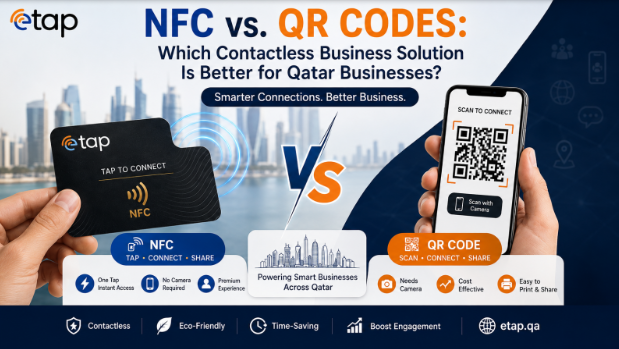
NFC vs. QR Codes: How Are They Different?
Although both technologies can perform similar tasks, their user experiences are different.
| Feature | NFC | QR Code |
| Interaction | Tap | Scan |
| Camera required | No | Yes |
| Physical chip | Yes | No |
| Printing required | Not for NFC function | Yes |
| Distance | Very short | Can be scanned from farther away |
| Cost | Higher | Very low |
| Digital links | Yes | Yes |
| Business cards | Excellent | Excellent |
| Menus | Excellent | Excellent |
| Google reviews | Excellent | Excellent |
| Social media | Excellent | Excellent |
| Custom branding | Excellent | Excellent |
Recent comparisons similarly describe NFC as particularly useful for fast, close-range interactions, while QR codes remain attractive because they are inexpensive and broadly accessible.
Why Businesses Choose NFC
1. Faster Interaction
NFC eliminates the camera-scanning step.
A customer can simply bring their phone close to the NFC product and access the associated digital destination.
This can be especially useful when a professional is networking at an exhibition or conference.
Instead of saying, “Please scan this QR code,” they can simply offer an NFC card and say, “Tap here to connect.”
2. Premium Customer Experience
The physical interaction with NFC can feel more modern and personalized.
For premium businesses, hotels, corporate offices, real estate companies, and professional service providers, the physical card or NFC stand can also become part of the company’s branding.
3. Works Without a Camera
QR codes depend on the phone’s camera being able to clearly see and recognize the code.
NFC doesn’t require a camera or line-of-sight scanning. The phone interacts directly with the NFC chip at close range.
4. Ideal for Business Cards
NFC is particularly well suited to professional networking.
An NFC business card can connect to a digital profile containing:
- Name
- Job title
- Company
- Phone
- Website
- Portfolio
- Location
- Appointment links
This provides significantly more flexibility than printing all the information on a traditional business card.
ETAP’s own NFC business-card solutions combine a physical branded card with a digital profile and can also provide QR-code access as an alternative.
Why Businesses Choose QR Codes
1. Low Cost
One of the biggest advantages of QR codes is affordability.
A QR code can be generated digitally and printed on:
- Business cards
- Flyers
- Posters
- Packaging
- Menus
- Product labels
- Counter displays
- Brochures
- Signboards
Businesses don’t need a physical NFC chip for every printed item.
2. Easy to Deploy
A restaurant can create a QR code for its menu and place it on hundreds of tables.
A retailer can print a QR code on product packaging.
A hotel can add QR codes to guest information materials.
This makes QR codes highly practical for large-scale applications.
3. Easy to Share Online
A QR code doesn’t have to be printed.
Businesses can also display QR codes on:
- Websites
- Presentations
- Social media
- Digital advertisements
- Emails
- Screens
This makes QR codes extremely versatile.
NFC or QR Code for Business Cards?
For business networking, NFC has a strong advantage because the physical tap creates a quick and memorable interaction.
However, that doesn’t mean businesses should completely eliminate QR codes.
In fact, the strongest solution is often to use both.
An NFC business card can have an NFC chip embedded inside it while also displaying a QR code.
This gives customers two options:
Tap if they want NFC.
Scan if they prefer QR.
The same digital profile can be behind both methods.
This approach provides flexibility without requiring a business to maintain two separate systems.
NFC or QR Code for Restaurants?
For restaurants and cafés, QR codes can be extremely practical.
A QR code can be placed directly on a table and used to open a digital menu.
However, NFC can add another layer of convenience. An NFC-enabled stand can allow customers to access menus, promotions, social media, or review pages with a tap.
For high-end restaurants and hospitality businesses, combining an NFC stand with a QR code can create both functionality and a premium presentation.
NFC or QR Code for Google Reviews?
Both technologies can be used to direct customers to a business’s Google review page.
For example, a business could place an NFC review stand at its reception counter.
A customer taps the stand and is directed toward the review page.
Alternatively, the same stand can display a QR code so customers can scan it.
This is particularly useful for:
- Restaurants
- Salons
- Clinics
- Hotels
- Retail stores
- Car dealerships
- Service businesses
The objective is to reduce the number of steps between a customer’s experience and their decision to leave feedback.
Which Is More Secure?
Security depends heavily on what the NFC or QR code is being used for.
For simple applications such as opening a website, menu, social media profile, or digital business card, both technologies can be used effectively.
For access control and identification, businesses should use appropriate RFID/NFC technologies, authentication systems, and security configurations rather than treating a basic NFC tag or QR code as a complete security system.
For example, Qatar businesses using access-control cards may require specific RFID or MIFARE technologies depending on their existing infrastructure and security requirements.
The right technology should therefore be selected according to the application rather than simply choosing NFC because it is newer.
Which Contactless Technology Is Better for Qatar Businesses?
There is no universal winner.
Choose NFC when:
- You want a premium tap-to-connect experience.
- You regularly network face-to-face.
- You need smart business cards.
- You want a physical branded product.
- You want customers to access information without scanning.
- You want to combine physical branding with a digital profile.
Choose QR codes when:
- You need a low-cost solution.
- You want to print the code on many items.
- You need customers to access information from a distance.
- You are creating menus, posters, packaging, or flyers.
- You want a simple solution with minimal hardware.
Choose Both when:
- You want maximum flexibility.
- You operate in different customer environments.
- You want NFC convenience with QR-code accessibility.
- You want one digital destination with multiple access methods.
Why Combining NFC and QR Codes Makes Sense
Instead of thinking of NFC and QR codes as competing technologies, businesses can treat them as two different access points to the same digital experience.
For example:
NFC Business Card
→ Tap → Digital Profile
QR Code
→ Scan → Digital Profile
WhatsApp Link
→ Click → Contact Business
All three can lead customers to the same online destination.
This makes the digital profile more important than the technology used to access it.
A well-designed digital profile should be mobile-friendly, fast, easy to navigate, and focused on the action the business wants the customer to take.
NFC and QR Solutions for Qatar Businesses
Businesses across Qatar can use contactless technologies in different ways depending on their industry.
Corporate offices can use smart cards for employee identification and access.
Hotels can use RFID/MIFARE cards for access and NFC solutions for guest engagement.
Restaurants can use QR codes and NFC stands for menus and reviews.
Retail businesses can use NFC and QR codes for product information and social media engagement.
Real estate professionals can use NFC business cards to share property listings and contact details.
Consultants and entrepreneurs can use NFC cards to share digital profiles and portfolios.
Clinics and service businesses can use NFC review cards to make customer feedback easier.
ETAP provides NFC, RFID, MIFARE, and smart-card solutions designed for different business applications in Qatar.
Final Verdict: NFC vs. QR Codes
So, which is better for Qatar businesses?
NFC is better for premium, fast, face-to-face interactions.
QR codes are better for low-cost, broad distribution.
But for many businesses, the smartest answer is NFC + QR Code.
An NFC business card with a QR-code backup, for example, gives professionals the convenience of tap-to-share while ensuring that customers who prefer scanning can still access the same digital profile.
The future of contactless business communication isn’t necessarily about choosing one technology over another. It’s about creating a seamless customer journey where physical products connect naturally with digital information.
For Qatar businesses looking to modernize networking, customer engagement, reviews, and smart-card applications, combining the right technology with a strong digital destination can create a faster and more professional experience.
ETAP – NFC & Smart Card Solutions Qatar helps businesses connect physical experiences with digital solutions, including NFC digital business cards, smart cards, RFID/MIFARE cards, and contactless customer-engagement products.
Connect. Share. Grow.
📞 WhatsApp: +974 55769142
🌐 ETAP – NFC & Smart Card Solutions Qatar
For more information about NFC business cards and how they work, see ETAP’s NFC Business Cards guide