A modern paint manufacturing facility relies on a series of specialized machines designed to ensure consistent quality, efficient production, and precise formulation control. From raw material handling to final filling, each stage of production requires carefully selected equipment to achieve stable dispersion, uniform color, and long-term product performance.
A Paint Production Line integrates multiple processing units that work together to produce high-quality coatings for industrial, automotive, decorative, and protective applications. Paint Production Line systems are designed to streamline operations, reduce waste, and maintain consistent batch quality across large-scale manufacturing environments.
Raw Material Storage and Handling Systems
The production process begins with proper storage and handling of raw materials such as resins, pigments, solvents, and additives. Efficient storage systems ensure material stability and reduce contamination risks.
Key equipment includes:
- Storage tanks for liquids and resins
- Silos or bins for powder pigments
- Automated feeding and dosing systems
These systems help maintain accurate formulation ratios and improve production efficiency.
High-Speed Dispersers
High-speed dispersers are essential for the initial mixing stage of paint production. They are used to break down pigment agglomerates and evenly distribute solids into liquid binders.
Their main functions include:
- Pre-mixing raw materials
- Initial pigment dispersion
- Reducing particle clumping
This stage is critical for achieving a uniform base mixture before fine grinding.
Bead Mills for Fine Grinding
Bead mills are one of the most important components in a paint production line. They are responsible for achieving fine particle size reduction and ensuring smooth, stable dispersion.
Key advantages include:
- High grinding efficiency
- Uniform particle size distribution
- Improved color strength and gloss
These machines are widely used in high-performance coatings where precision is essential.
Mixing and Blending Tanks
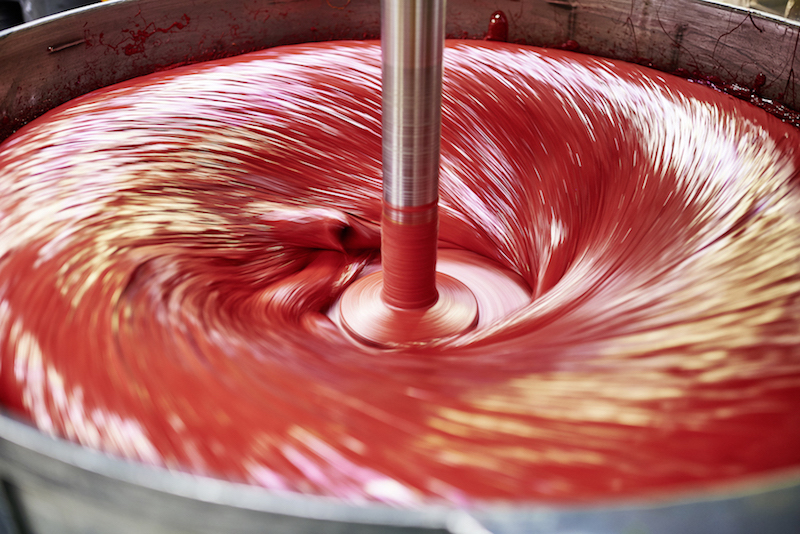
Mixing tanks are used throughout the production process to ensure uniform consistency and stability of the paint formulation. Equipped with agitators, these tanks help maintain proper viscosity and homogeneity.
Functions include:
- Homogenizing dispersed materials
- Maintaining stable viscosity levels
- Supporting batch and continuous production
They are essential for both small and large-scale manufacturing setups.
Filtration Systems
Filtration systems are used to remove impurities, oversized particles, and contaminants from the paint mixture before packaging. This ensures a smooth and defect-free final product.
Common filtration equipment includes:
- Mesh filters
- Bag filters
- Cartridge filtration units
Proper filtration improves product quality and prevents application issues.
Vacuum Deaeration Units
Air bubbles trapped in paint can negatively affect coating quality and appearance. Vacuum deaeration systems remove entrapped air to ensure a smooth and stable product.
Benefits include:
- Improved coating uniformity
- Reduced surface defects
- Enhanced product stability
This step is especially important for high-end decorative and industrial coatings.
Automatic Filling and Packaging Machines
Once the paint is fully processed, it is transferred to filling and packaging systems. These machines ensure accurate filling, sealing, and labeling of containers.
Key features include:
- High-precision filling systems
- Automated sealing mechanisms
- Labeling and batch coding units
Automation improves efficiency and reduces manual labor.
Control and Automation Systems
Modern paint production lines rely heavily on automation to maintain consistency and efficiency. Centralized control systems manage the entire production process.
These systems provide:
- Real-time monitoring of production parameters
- Automated process adjustments
- Data recording and quality control
Automation ensures stable output and minimizes human error.
Conclusion
A well-designed paint production setup requires a combination of advanced equipment working in harmony. From raw material handling and dispersion to grinding, filtration, and packaging, each stage plays a vital role in ensuring product quality and efficiency.
By integrating modern technologies within a Paint Production Line, manufacturers can achieve higher productivity, better consistency, and improved operational control, making it an essential solution for today’s competitive coatings industry.