
A Brokerage Account is a financial account that allows individuals to invest in assets such as stocks, bonds, mutual funds, and exchange-traded funds. You must learn how to compute Brokerage Account returns because this skill enables you to evaluate your investment achievements during particular time intervals.
The article provides an organized presentation of the procedure which readers can easily understand.
What Does Return Mean?
Return represents the value progression of your investments during a specified time. The three primary components of return are:
Your investments have experienced a change in their market worth
Your investments earned income through dividends and interest
The costs you incurred included fees and charges
A complete return calculation includes all of these elements.
Step 1: Identify the Initial and Final Value
Start by noting the value of your Brokerage Account at the beginning and at the end of the selected period.
- Initial Value: Total value at the start
- Final Value: Total value at the end
Formula:
Return = Final Value − Initial Value
The total change in value is calculated through this method.
Step 2: Adjust for Contributions and Withdrawals
The calculation requires adjustment when you made contributions or withdrew money during the time period.
- Contributions increase the invested amount
- Withdrawals reduce the invested amount
The formula adjustments for calculation changes as follows:
Adjusted Return = Final Value − Initial Value − Contributions + Withdrawals
The return calculation should only reflect actual investment results through this step.
Step 3: Add Income Earned
A Brokerage Account may generate income during the investment period. The income earned during the investment period must be counted toward the total return calculation.
These are examples of the situation:
- According to the payment terms, investors of shares receive dividend distributions.
- Bondholders receive interest payments
- Mutual funds make distributions to their investors
The formula adjustments create a new equation for measurement of total return:
Total Return = Adjusted Return + Income
Step 4: Subtract Fees and Charges
The process of deducting fees from total return leads to reduced returns for investors. These expenses encompass:
- Brokerage fees
- Transaction charges
- Account maintenance fees
Net Return Formula:
Net Return = Total Return − Fees
The method calculates actual returns which investors receive after all expenses have been deducted.
Step 5: Convert the Return into a Percentage
The percentage conversion of return values enables better understanding of return performance.
Formula:
Percentage Return = (Net Return ÷ Initial Value) × 100
The percentage return enables easier comparison of different investments which leads to better performance assessment.
Step 6: Calculate Annualized Return
Investors can find annualized return when their investment period extends beyond one year. The standardization process helps create uniform results.
Formula:
The annualized return calculates the final value from the initial value through a defined time period.
Annualized Return =
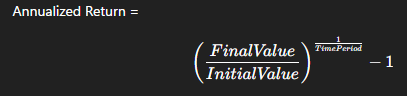
The time period is measured in years.
Step 7: Understand Different Return Methods
The two methods for return measurement which people use most are:
Time-Weighted Return
The method focuses exclusively on investment performance. Money added or withdrawn during the period does not affect the results.
Money-Weighted Return
The method requires complete knowledge of cash movements between both their amounts and their timing. The internal rate of return (IRR) method is used to calculate the financial metric.
The distinct methods of assessment require different analysis techniques because they assess performance through separate evaluation procedures.
Example Calculation
Consider the following example:
- Initial Value: ₹1,00,000
- Final Value: ₹1,20,000
- Contributions: ₹10,000
- Withdrawals: ₹5,000
- Income: ₹2,000
- Fees: ₹1,000
Step-by-step calculation:
- Adjusted Return:
₹1,20,000 − ₹1,00,000 − ₹10,000 + ₹5,000 = ₹15,000 - Add Income:
₹15,000 + ₹2,000 = ₹17,000 - Subtract Fees:
₹17,000 − ₹1,000 = ₹16,000 - Percentage Return:
(₹16,000 ÷ ₹1,00,000) × 100 = 16%
This represents the return for the given period.
Calculating returns using simple tools
- Microsoft Excel
- Google Sheets
- Online calculators available on brokerage platforms
The tools enable users to input data while maintaining correct formula application throughout their work.
Key Points to Remember
- Always include all contributions and withdrawals
- Add any income earned during the period
- Subtract all fees and charges
- Use the correct time period
- Apply the same method for consistent comparison
Conclusion
The process of calculating return on a Brokerage Account requires four fundamental steps to complete. The process begins with identifying the initial and final value of the investment. It also requires adjustments for contributions and withdrawals during the selected period. Investors should subtract all applicable fees and include earned income to calculate accurate returns. Using a Brokerage Calculator can further help estimate brokerage charges and analyse actual trading costs more efficiently. The final result can then be presented as a percentage or annualized return.
This structured approach enables investors to monitor investment performance while maintaining proper financial records across different time periods.