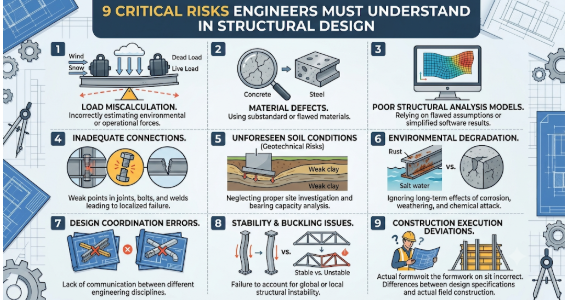
The construction industry demands accuracy, planning, and technical expertise at every stage of a project. As structures become more complex, engineers must understand the risks involved in designing and developing safe infrastructure. Knowledge of civil and structural engineering helps professionals evaluate different challenges, improve decision-making, and create structures that perform reliably under various conditions.
Structural failures rarely occur because of a single mistake. They are often the result of multiple factors, including design limitations, incorrect analysis, material issues, and poor planning. Understanding these risks allows engineers to take preventive measures and improve overall project quality.
Incorrect Load Assessment
One of the most critical challenges in structural design is accurately understanding the forces acting on a structure. Buildings experience different types of loads, including dead loads, live loads, wind pressure, and seismic forces.
Incorrect load estimation can affect the stability and durability of a structure. Engineers must carefully analyze how these forces interact with different components before finalizing a design. Accurate calculations help prevent structural weaknesses and ensure that buildings can safely handle expected conditions.
Modern analysis techniques allow professionals to evaluate various load scenarios before construction begins, reducing uncertainty and improving design reliability.
Poor Structural Planning
A strong design begins with proper planning. Structural decisions made during the early stages influence the entire construction process, from material selection to project execution.
Poor planning can lead to inefficient designs, increased costs, and construction delays. Engineers must consider factors such as building purpose, environmental conditions, and future requirements while developing structural solutions.
A well-planned approach ensures that every element works together effectively and supports the long-term performance of the structure.
Limited Software Knowledge
Digital tools have transformed the way engineers analyze and design structures. However, limited understanding of these technologies can create challenges in modern engineering environments.
Software applications help professionals create models, test performance, and identify potential issues before construction. Learning how these tools function allows engineers to make more informed decisions and improve accuracy.
Understanding ETABS software used in civil engineering provides valuable knowledge of structural modeling, analysis, and design processes. Engineers who develop software skills can adapt better to technology-driven project workflows and industry expectations.
Ignoring Environmental Conditions
Every construction site has unique environmental factors that influence structural performance. Weather conditions, soil characteristics, temperature changes, and natural forces must be considered during design.
Ignoring these elements can reduce the lifespan of a structure and increase maintenance requirements. Engineers need to evaluate local conditions carefully to create designs suitable for their specific environments.
Structures built without considering environmental factors may experience problems such as excessive movement, material deterioration, or reduced stability over time.
Inadequate Material Selection
Materials play an important role in determining the strength and durability of a structure. Selecting inappropriate materials can affect safety, maintenance, and overall project efficiency.
Engineers must understand material properties and how they behave under different conditions. Factors such as strength, flexibility, resistance to environmental exposure, and cost should be considered before making decisions.
Proper material selection ensures that structures maintain their performance throughout their intended lifespan while meeting safety requirements.
Weak Construction Coordination
Even the best designs can face challenges if communication between project teams is ineffective. Construction involves collaboration between engineers, architects, contractors, and suppliers.
Poor coordination can result in design misunderstandings, incorrect implementation, and unnecessary delays. Engineers must communicate technical information clearly and ensure that construction teams understand project requirements.
Strong coordination improves accuracy and helps maintain consistency between design concepts and actual construction outcomes.
Lack of Practical Training
Engineering knowledge becomes more valuable when combined with practical experience. Professionals who understand only theoretical concepts may find it difficult to handle real project challenges.
Practical exposure helps engineers understand how designs are implemented, how problems appear on-site, and how solutions are developed. A strong structural engineering training approach allows learners to connect classroom knowledge with industry practices.
Hands-on learning improves confidence and prepares engineers to manage complex situations during professional projects.
Poor Safety Evaluation
Safety evaluation is a continuous process that extends from design to construction and maintenance. Engineers must regularly assess whether structures meet required safety standards.
Failure to conduct proper evaluations can create risks for occupants and reduce structural reliability. Advanced analysis methods help engineers identify potential weaknesses and make necessary improvements.
A safety-focused approach ensures that structures remain dependable even when exposed to challenging conditions throughout their service life.
Ignoring Future Requirements
Buildings are not designed only for present needs. Engineers must consider how structures may be used and maintained in the future.
Changing occupancy patterns, technological upgrades, and environmental concerns can influence structural requirements over time. Flexible designs allow buildings to adapt without requiring major modifications.
Considering future needs during the design stage improves sustainability and increases the long-term value of infrastructure projects.
Building Better Solutions Through Risk Awareness
Understanding structural risks helps engineers create better solutions rather than simply responding to problems after they occur. Risk assessment encourages careful planning, accurate analysis, and improved decision-making throughout the project lifecycle.
Modern engineering focuses on prevention rather than correction. By identifying possible challenges early, professionals can reduce failures, control costs, and improve overall project performance.
This approach is becoming increasingly important as construction projects continue to grow in scale and complexity.
Conclusion
Understanding risks in structural design is essential for creating safe, durable, and efficient infrastructure. Engineers who develop strong technical knowledge, practical experience, and software expertise can manage complex project challenges effectively. Continuous learning and industry-focused development help professionals stay prepared for changing construction requirements and advanced engineering practices. By improving their analytical abilities, engineers can make better design decisions and contribute to safer project outcomes. Practical knowledge gained through structural engineering training further enhances their ability to apply concepts effectively in real-world environments. Civilera provides structured learning opportunities that help aspiring professionals strengthen their engineering skills and prepare for successful careers in the evolving construction industry.